Where to Drink: Finsborough Wine Cafe
Location: London, SW10 9ED
This entry was published on 05 Mar 12, but I'm sad to say that since Sep 12, Finsborough Wine Cafe closed down.
A wine bar can be a classy and elegant way of enjoying an evening, but it can get quite pricey, so we generally go only when there's a big event on, or we're invited to a party. This weekend we were able to attend a 30th birthday do held in the wine cellar at Finsborough Wine Cafe, and I cannot recommend it more highly.
You can hire the cellar or the whole place out for an evening, and our host did the former. The downstairs area alone is quite a big space with a rustic feel to it: sturdy wooden tables and benches line the cellar along with rows and rows of wine bottles, and the room is softly lit to create a nice ambiance.
We were served lovely canapes of cheese and ham and bread, olives and nuts, accompanied at first by a delicious and sweet sparkling rosé - Ackerman Laurance Sparkling Rosé NV. Normally some of us don't like sparkly/champagne drinks, but this one was perfect and went down well with everyone. There was also just enough food to fill us up so that the liquids could go down easily.
The atmosphere's excellent, but perhaps that's due to the quality of the people attending the party. The music was turned on much later and dancing started quite late. Near the end, we tried a bottle of white - Invivo Pinot Gris 2011 - and it was amazing. I absolutely loved it, and it had a beautiful aftertaste!
For a wine bar, their prices are extremely reasonable. They have a wine tasting event where you can explore 10 wines for just 9 quid. They also have happy hour prices daily until 7pm, and are willing to match prices or go lower than any other London location (supermarkets or otherwise).
I'd definitely return to this place, the only problem is that it's in West Brompton, a bit far from my usual haunts. However, this was well worth a trek!
PS: my favourite wine bar in the UK so far is John Gordons in Cheltenham. Charming atmosphere, with live jazz performances in the open space outside. Prices are a bit steep, but I can't wait for the weather to get better ... I'll write a proper review of this once I go again.
Monday, 5 March 2012
Thursday, 1 March 2012
Wildlife Photography of the Year 2011
Event: Wildlife Photography of the Year 2011
Location: Oxford Science (and other locations across the UK)
Every year, we go to the Wildlife Photography of the Year exhibition. I'm not sure how the tradition started. It must have been that we accidentally stumbled upon it once at the Natural History Museum, and then ever since, we would make an effort to catch it annually.
Interestingly, this show goes on tour after a few months, and we caught it in Bristol last year, and Oxford this year.
My friend already gave it a good review, but to add to that, it is absolutely fascinating how good photography can really make people interested in the most common of things.
I love the unique perspectives and close-ups: for example, this beautiful image of a bee and flower is simple yet stunning. This exhibition also makes a point to award young photographers, good story-telling, and those who draw people's attention to endangered species and environmental disasters.
Undoubtedly, we purchase the wildlife postcards every year just because the photos are too beautiful to forget. This time, however, something funny happened - my friend started juggling some random balls in the gift shop, and when we were about to pay for the postcards, the cashier (manager?) gave him some real juggling balls to perform for a bit. Obligingly, my friend did a few tricks, and then the cashier let us have the postcards for free! Haha!
The tour is still going on now, you can catch it at various locations across the UK, including Yorkshire, Wales and Cumbria.
Location: Oxford Science (and other locations across the UK)
Interestingly, this show goes on tour after a few months, and we caught it in Bristol last year, and Oxford this year.
My friend already gave it a good review, but to add to that, it is absolutely fascinating how good photography can really make people interested in the most common of things.
I love the unique perspectives and close-ups: for example, this beautiful image of a bee and flower is simple yet stunning. This exhibition also makes a point to award young photographers, good story-telling, and those who draw people's attention to endangered species and environmental disasters.
Undoubtedly, we purchase the wildlife postcards every year just because the photos are too beautiful to forget. This time, however, something funny happened - my friend started juggling some random balls in the gift shop, and when we were about to pay for the postcards, the cashier (manager?) gave him some real juggling balls to perform for a bit. Obligingly, my friend did a few tricks, and then the cashier let us have the postcards for free! Haha!
The tour is still going on now, you can catch it at various locations across the UK, including Yorkshire, Wales and Cumbria.
Bookclub with Alan Hollinghurst
Coming soon: Alan Hollinghurst talks about Line of Beauty
Location: BBC Radio 4
So I generally write here after an event occurs, but this one time, I finally remember to share with you something I'm quite looking forward to: Booker-winning Alan Hollinghurst will talk to readers about his book Line of Beauty this Sunday 4 March, on BBC Radio 4 at 4pm.
You can find a synopsis of the book here:
http://www.bbc.co.uk/programmes/b01cvgbr
Although I liked his Swimming-Pool Library and his latest novel Stranger's Child more, Hollinghurst definitely deserved his award for Line of Beauty.
Anyway, if you haven't read it yet, it's time to pick up the book and speed through it in time for the radio show!
PS: if you run out of time, you can download the podcast and enjoy his talk later
Location: BBC Radio 4
You can find a synopsis of the book here:
http://www.bbc.co.uk/programmes/b01cvgbr
Although I liked his Swimming-Pool Library and his latest novel Stranger's Child more, Hollinghurst definitely deserved his award for Line of Beauty.
Anyway, if you haven't read it yet, it's time to pick up the book and speed through it in time for the radio show!
PS: if you run out of time, you can download the podcast and enjoy his talk later
Saturday, 31 December 2011
Best of 2011
I haven't attended or done as many cultural events this year as the previous years, but I tried my best. The following are some of the highlights (*some of the items below are quite dated, like Cloud Atlas, but I read it this year):
- Films: Jane Eyre, Where the Wild Things Are, Tinker Tailor Soldier Spy, Midnight in Paris, MI4 (Hehe)
- Books: Teach Us to Sit Still, Cloud Atlas, The Wilderness, The Man who Mistook his Wife for a Hat, It's a Book, Stranger's Child
- Poetry: Family Values
- TV: Mad Men Season 4
- Events: Bath Lit Fest, Chelt Lit Fest, Decemberists Concert, Feist Concert, Secret Cinema, Stoke Newingham Lit Fest, Eels Concert, Magritte Exhibit at Liverpool, Thanksgiving in Dorset, Sylvia Plath's drawings at Mayor Gallery, Cirque du Soleil - Zaia, Some like it Hip Hop at Sadler's Wells
- Places: Google HQ, Casa Batllo, Saltaire, Big Buddha
- Food/Beverage: Schwartz's in Montreal, Manpuku in Toronto, Magdalen Arms in Oxford, Hotel Bellevue at Sorrento, Printer's House, Lang Fong Yuen in HK, Isis Farmhouse in Oxford, Mercato Caterina in Barcelona
Low points:
- Books: Time Traveller's Wife, Hunger Games Trilogy (don't ask), Great House
- Events: RADA's Reigen (ugh!)
Thursday, 10 February 2011
World Book Night giveaway
Event: World Book Night (Saturday 5 March)
Locations: All over the UK
I'm really excited to be participating in the World Book Night giveaway. Yes, there have been concerns that the book industry will be inundated with a million free books, and that authors and independent bookshop owners would suffer because of this event, but I think there's a lot going for it, and I for one am very happy to be involved!
The book I'm giving away is Love in the Time of Cholera, by G G Marquez.
Have you heard of this book only because of the film? (I wouldn't really recommend seeing the film first though. Not as good as the original!) The synopsis is as follows:
If *you* are interested in reading this book, please let me know! I'm open to mailing out a few copies! Please leave a message with your email if so.
Who would like this book?
In my opinion, readers who enjoy a bit of Latin American history, a bit of magic, a bit of romance, would like it.
More about the event:
Locations: All over the UK
I'm really excited to be participating in the World Book Night giveaway. Yes, there have been concerns that the book industry will be inundated with a million free books, and that authors and independent bookshop owners would suffer because of this event, but I think there's a lot going for it, and I for one am very happy to be involved!
Have you heard of this book only because of the film? (I wouldn't really recommend seeing the film first though. Not as good as the original!) The synopsis is as follows:
Fifty-one years, nine months and four days have passed since Fermina Daza rebuffed hopeless romantic Florentino Arizo’s impassioned advances and married Dr. Juvenal Urbino instead. During that half century, Florentino has fallen into the arms of many delighted women, but has loved none but Fermina. Having sworn his eternal love to her, he lives for the day when he can court her again.My grand plan is to try and leave the majority of the 48 books that I'm given in random locations around different cities (I travel frequently) and hope that people, book lovers or not, would pick them up and take care of them. Also, what I'd love to see is people discussing the book after they read it, so I'll be leaving a note inside each book. I will also name a few suggestions for further reading for those who enjoyed the book. I will also donate the books to local charities and friends who have not read the book before.When Fermina’s husband is killed trying to retrieve his pet parrot from a mango tree, Florentino seizes his chance to declare his enduring love. But can young love find new life in the twilight of their lives?
If *you* are interested in reading this book, please let me know! I'm open to mailing out a few copies! Please leave a message with your email if so.
Who would like this book?
In my opinion, readers who enjoy a bit of Latin American history, a bit of magic, a bit of romance, would like it.
More about the event:
One million books will be given away by an army of passionate readers to members of the public across the UK and Ireland. The book give-away will comprise 40,000 copies of each of the 25 carefully selected titles, to be given away by 20,000 ‘givers’, who will each distribute 48 copies of their chosen title to whomever they choose on World Book Night. The remaining books will be distributed by World Book Night itself in places that might otherwise be difficult to reach, such as prisons and hospitals.There are also lots of interesting programmes on BBC relating to World Book Night. You can find out more here: http://www.bbc.co.uk/pressoffice/pressreleases/stories/2011/01_january/25/events.shtml
Monday, 20 December 2010
Evolving English and Mick Imlah
Events: British Library's Evolving English and Memorial Reading: Mick Imlah
Locations: British Library and Senate House
British Library's Evolving English* is a small but fascinating exhibition on the history of the English language. It covers from its very beginning -- Anglo Saxons, Beowulf, Old English, etc -- to its very latest forms, such as text-speak, post-colonial english, slangs and dialects ... There is enough material there to interest the historian, the paleographer, the teenager and the farmer.
What I found most interesting were the booths where you can listen to recordings of regional dialects and accents in the UK. Annoyingly though, there are only two booths, so if you go at prime time (weekends) then you might have to line up an age to listen. You can also participate in the national sound archive by getting a recording of your voice taped. One of the exercises involved you reading an edited version of Mr Tickle.
David Crystal does a good explanation of Beowulf and its historic significance: only about 500 Old English texts survive us, and we can identify about 3000 distinct Old English words - this is meaningless unless you compare it to our current English language. Dickens` novels alone contain more than 3000 distinct words, so imagine *all* the words that are available to us now, and compare that to the limited vocabulary of Old English (OE)! So Beowulf is a very important piece of artefact because it`s the longest text written in OE by far (OE = 600-1150 AD. Middle English = 1300 - 15th cen). There is a copy of it exhibited.
Other things of interest: you can hear Joyce read his Finnegan`s Wake, you can hear Gandhi and Churchill and other famous speakers recite, in their distinctive voice. You can also learn that the Victorian novelist Bulwer-Lytton (who?!) coined the phrase 'it was a dark and stormy night', as well as 'the pen is mightier than the sword'. Or that the 'knock-knock' joke is very old (you can find it in Macbeth as well! 'Knock-knock - who's there?')
Chaucer's Canterbury Tales (a Middle English classic) is also shown. Next to it is the oldest (?) score of Summer is icumen round - the blurb next to it explains that in Middle English, the word Spring did not exist, so the word cuckoo had to be used to illustrate the idea of Spring. Why would you have Summer but not Spring? Isn't Spring an important time for farmers, labourers, etc? Huh. Oh and in that song is the first record of the root word of fart (hehe!) - 'to farteth'.
Lastly, an exhibition about accents and dialects could not be complete without a showing of My Fair Lady! I knew that they must use that film in some way. Oh you can also listen to Lily Allen sing LDN, read about Nancy Mitford on the U and Non-U issue, find out about censorship and profanity in relation to DH Lawrence and his generous use of c*nt, get a sense of the history of children's books (started only in the 18th century) .... and I could go on!
Exhibit runs until next April. Check. It. Out.
*The exhibit has an accompanying book with the most hideous cover design ever! (See above image)
A
s for Mick Imlah, I actually don't have too much to say about him as I've never heard of him until about two weeks ago. And the only reason I went to see a memorial reading of his poetry is the list of distinguished readers. Alan Hollinghurst: swoon! Andrew Motion: cool! Martin Amis: ugh, but still ...
Ok it seems like his poetry cannot be found on the internet. Faber & Faber just launched a selected poetry collection of his, so go buy it and read it.
Anyway, I was glad to have attended the reading, not only because one of my favourite writers was there ... but that the poems were witty, humourous, and had perfect structures (as all the readers were inclined to say). I particularly liked the lightheartedness of 'In Memoriam Alfred Lord Tennyson' -- and the fact that Hollinghurst shared a funny anecdote about Imlah handing the poem in very very late for the TLS issue celebrating the centenial anniversary of Tennyson ... He was incredibly worried that Imlah could only make it to celebrate the next centenary. Ha.
Also, 'Stephen Boyd' was very good. Again, I can't find a decent excerpt of the poem, so here is a review for you to read, from poetrymagazines.org.
I will try to read more of his poetry next year ... for the record, this year I only managed to finish the measly number of 23 books, 2 less than my goal. I used to read 100 books per annum. Those were the days. Last year, I read less than 10. What a disgrace. Hmm ... something new year's resolution something ...
To conclude:
Happy holidays to all who read this blog! (All four or five of you, I dare say!) I will be back in the new year ...
Locations: British Library and Senate House
British Library's Evolving English* is a small but fascinating exhibition on the history of the English language. It covers from its very beginning -- Anglo Saxons, Beowulf, Old English, etc -- to its very latest forms, such as text-speak, post-colonial english, slangs and dialects ... There is enough material there to interest the historian, the paleographer, the teenager and the farmer.
David Crystal does a good explanation of Beowulf and its historic significance: only about 500 Old English texts survive us, and we can identify about 3000 distinct Old English words - this is meaningless unless you compare it to our current English language. Dickens` novels alone contain more than 3000 distinct words, so imagine *all* the words that are available to us now, and compare that to the limited vocabulary of Old English (OE)! So Beowulf is a very important piece of artefact because it`s the longest text written in OE by far (OE = 600-1150 AD. Middle English = 1300 - 15th cen). There is a copy of it exhibited.
Other things of interest: you can hear Joyce read his Finnegan`s Wake, you can hear Gandhi and Churchill and other famous speakers recite, in their distinctive voice. You can also learn that the Victorian novelist Bulwer-Lytton (who?!) coined the phrase 'it was a dark and stormy night', as well as 'the pen is mightier than the sword'. Or that the 'knock-knock' joke is very old (you can find it in Macbeth as well! 'Knock-knock - who's there?')
Chaucer's Canterbury Tales (a Middle English classic) is also shown. Next to it is the oldest (?) score of Summer is icumen round - the blurb next to it explains that in Middle English, the word Spring did not exist, so the word cuckoo had to be used to illustrate the idea of Spring. Why would you have Summer but not Spring? Isn't Spring an important time for farmers, labourers, etc? Huh. Oh and in that song is the first record of the root word of fart (hehe!) - 'to farteth'.
Lastly, an exhibition about accents and dialects could not be complete without a showing of My Fair Lady! I knew that they must use that film in some way. Oh you can also listen to Lily Allen sing LDN, read about Nancy Mitford on the U and Non-U issue, find out about censorship and profanity in relation to DH Lawrence and his generous use of c*nt, get a sense of the history of children's books (started only in the 18th century) .... and I could go on!
Exhibit runs until next April. Check. It. Out.
*The exhibit has an accompanying book with the most hideous cover design ever! (See above image)
A
Ok it seems like his poetry cannot be found on the internet. Faber & Faber just launched a selected poetry collection of his, so go buy it and read it.
Anyway, I was glad to have attended the reading, not only because one of my favourite writers was there ... but that the poems were witty, humourous, and had perfect structures (as all the readers were inclined to say). I particularly liked the lightheartedness of 'In Memoriam Alfred Lord Tennyson' -- and the fact that Hollinghurst shared a funny anecdote about Imlah handing the poem in very very late for the TLS issue celebrating the centenial anniversary of Tennyson ... He was incredibly worried that Imlah could only make it to celebrate the next centenary. Ha.
Also, 'Stephen Boyd' was very good. Again, I can't find a decent excerpt of the poem, so here is a review for you to read, from poetrymagazines.org.
I will try to read more of his poetry next year ... for the record, this year I only managed to finish the measly number of 23 books, 2 less than my goal. I used to read 100 books per annum. Those were the days. Last year, I read less than 10. What a disgrace. Hmm ... something new year's resolution something ...
To conclude:
Happy holidays to all who read this blog! (All four or five of you, I dare say!) I will be back in the new year ...
Wednesday, 8 December 2010
Matthew Bourne's Cinderella
Event: Matthew Bourne's Cinderella
Location: Sadler's Wells
Instead of a pumpkin-turned-carriage,
Cinder to the ball in a motorcycle sidecar!
In any case, I loved his Swan Lake and decided to see his CInderella. I tried to not find out too much about the ballet so as to keep the surprise up, but I did read the synopsis - celebrating the 70th anniversary of the London Blitz, Bourne made 1940 the setting of his Cinderella. The skeleton framework of the Cinderella fairytale is still there - the evil stepmother, evil stepsisters, handsome romantic love interest, the stroke of midnight, the faerie god-figure, the happily-ever-after. Those were about it though. Cinderella (Cin) has a very large family: not just the three evil steps, but her father's still alive (an invalid here) and she has a bunch of crazy, perverted stepbrothers (Bourne seems to enjoy creating sexually uninhibitive characters).
The three acts all start off with clear reminders of the setting: Act 1 and 3 both begin with the sound of air raid sirens, then by hilarious newsreels of 'what to do in an air raid' (typically shown before main film features in mid-20th century). Act 2 scarily opens with the unexpected sound of the bomb: you really are quite immersed in the time period because of all those features, and also, a lot of 'period sounds' are present in the score. Bourne definitely tempers with Prokofiev's music, but it is done extremely tastefully (well, as tasteful as adding siren sounds to classical music can ever be). Prokofiev's music is quite haunting and poetic, and Bourne keeps that aspect up in most of his choreography. The dance moves are quite unusual at times though, and I couldn't tell what the references are. Perhaps West Side Story, perhaps some strange form of 40s swing dancing.
In another gender-breaking move, he makes the faerie godmother a godfather, and his choreography is very much like a swan's (like Bourne's Swan Lake). The faerie dancer looks a bit like this guy ... maybe he's modelled after him?
What I like about Bourne's ballets is that the line between reality and fantasy is often blurred. In Cinderella, it is quite hard to tell whether what you're watching is a dream sequence or a real one. The scenes often unfold, sometimes achronologically, in a way that does not allow you to pin down the context. For example, Act 2 starts with the thundering sound of the bomb, and the curtains open up to a ballroom scene totally devastated by the bomb, presumably. But within minutes, the faerie comes and reverses time, so that the ballroom is in pristine order. Then the conventional storyline unveils (girl meets boy, girl dances with boy, midnight strikes ... she loses her beautiful ballgown), but then once midnight passes, the scene switches back to a warzone with Cinder injured, and you wonder whether the romantic scene happened at all. Was it all a dream? Did they really have sex after midnight? Does it matter though?
Everything is so seamless, so magical, that it is no longer important to figure out whether we are seeing the real or the artificial. I was mesmerised by the humour, by the sexual openness, by the differences between the original and this version, and finally, by the references to real life London (Act 3 has an Underground scene, then a Thames riverbank scene, and ends in Paddington Station).
Last but not least, my favourite scene: it has to be the part when Cinder re-imagines meeting her 'prince' - an amnesiac RAF (ha!). She starts dancing with a seamstress' mannequin, happily and energetically twirls behind the curtains, and then re-emerges with the real life RAF man! I love it. What a wonderful moment of magic-realism. And then they dance together, but after a while, we are made aware of the dream element because their dance starts to become stilted. The man would stop picking her up, move mechanically like a mannequin, etc etc. So funny! And then of course, it ends with the man turning back into the dummy.
Beautiful! You can see a short clip here for yourself: http://www.youtube.com/watch?v=DMOFjZSovR0
PS: read my review of Bourne's latest ballet: Sleeping Beauty
Location: Sadler's Wells
Like most people, I discovered the contemporary choreographer Matthew Bourne through this film (I still get shivers watching that scene). So earlier this year, I went off to Cardiff to gain my first Matthew Bourne experience. I was not prepared for the ballet: shocked not at the content per se, but that I wasn't expecting Swan Lake to be reinterpreted in that particular way. Of course it was going to be unconventional, with a male protagonist instead of a female, but I didn't know it would be a homoerotic psychological thriller, which is worlds apart from the original Swan Lake narrative.
Cinder to the ball in a motorcycle sidecar!
In any case, I loved his Swan Lake and decided to see his CInderella. I tried to not find out too much about the ballet so as to keep the surprise up, but I did read the synopsis - celebrating the 70th anniversary of the London Blitz, Bourne made 1940 the setting of his Cinderella. The skeleton framework of the Cinderella fairytale is still there - the evil stepmother, evil stepsisters, handsome romantic love interest, the stroke of midnight, the faerie god-figure, the happily-ever-after. Those were about it though. Cinderella (Cin) has a very large family: not just the three evil steps, but her father's still alive (an invalid here) and she has a bunch of crazy, perverted stepbrothers (Bourne seems to enjoy creating sexually uninhibitive characters).
The three acts all start off with clear reminders of the setting: Act 1 and 3 both begin with the sound of air raid sirens, then by hilarious newsreels of 'what to do in an air raid' (typically shown before main film features in mid-20th century). Act 2 scarily opens with the unexpected sound of the bomb: you really are quite immersed in the time period because of all those features, and also, a lot of 'period sounds' are present in the score. Bourne definitely tempers with Prokofiev's music, but it is done extremely tastefully (well, as tasteful as adding siren sounds to classical music can ever be). Prokofiev's music is quite haunting and poetic, and Bourne keeps that aspect up in most of his choreography. The dance moves are quite unusual at times though, and I couldn't tell what the references are. Perhaps West Side Story, perhaps some strange form of 40s swing dancing.
In another gender-breaking move, he makes the faerie godmother a godfather, and his choreography is very much like a swan's (like Bourne's Swan Lake). The faerie dancer looks a bit like this guy ... maybe he's modelled after him?
What I like about Bourne's ballets is that the line between reality and fantasy is often blurred. In Cinderella, it is quite hard to tell whether what you're watching is a dream sequence or a real one. The scenes often unfold, sometimes achronologically, in a way that does not allow you to pin down the context. For example, Act 2 starts with the thundering sound of the bomb, and the curtains open up to a ballroom scene totally devastated by the bomb, presumably. But within minutes, the faerie comes and reverses time, so that the ballroom is in pristine order. Then the conventional storyline unveils (girl meets boy, girl dances with boy, midnight strikes ... she loses her beautiful ballgown), but then once midnight passes, the scene switches back to a warzone with Cinder injured, and you wonder whether the romantic scene happened at all. Was it all a dream? Did they really have sex after midnight? Does it matter though?
Everything is so seamless, so magical, that it is no longer important to figure out whether we are seeing the real or the artificial. I was mesmerised by the humour, by the sexual openness, by the differences between the original and this version, and finally, by the references to real life London (Act 3 has an Underground scene, then a Thames riverbank scene, and ends in Paddington Station).
Last but not least, my favourite scene: it has to be the part when Cinder re-imagines meeting her 'prince' - an amnesiac RAF (ha!). She starts dancing with a seamstress' mannequin, happily and energetically twirls behind the curtains, and then re-emerges with the real life RAF man! I love it. What a wonderful moment of magic-realism. And then they dance together, but after a while, we are made aware of the dream element because their dance starts to become stilted. The man would stop picking her up, move mechanically like a mannequin, etc etc. So funny! And then of course, it ends with the man turning back into the dummy.
Beautiful! You can see a short clip here for yourself: http://www.youtube.com/watch?v=DMOFjZSovR0
PS: read my review of Bourne's latest ballet: Sleeping Beauty
Sunday, 14 November 2010
RCA Secret 2010
Event: RCA Secret 2010
Location: Royal College of Art
The RCA Secret Postcard event is an annual art exhibition that shows and sells postcards made by famous artists and personalities, as well as students from the Royal College of Art. It is billed as a 'secret' event because 'the postcards are displayed anonymously and are signed on the reverse, so that the artist remains a secret until after the cards are purchased and their signature is revealed on the back.'
I read that Yoko Ono contributed artwork to this event, so I decided to check it out just now ... it was fun at first, going through walls and walls of tiny artworks, but after a while, it got a bit overwhelming. Not having any labels on the postcards actually made it a lot more of a difficult task to analyse and judge what was 'good' and what was not. Museums usually help you along because you trust that someone with the right expertise curated the show and put together artworks that mean something together or would provoke and guide your thoughts towards a theme or an idea. But with this random collection of 2800 postcards, who knew which postcard was a 'great' piece of art or not?
It was kind of fun to guess which one was created by a famous person. I couldn't find a single one that screamed Yoko Ono, which made me wonder if the artists played along by not creating any of their usual signature styles. Other famous celebrities who made contributions were: Stella McCartney, Will Alsop (architect), Manolo Blahnik, Quentin Blake, Mike Leigh ... there was also an Emma Watson, but is she the famous Harry Potter-franchise figure or not?
Anyway, after a bit of guessing, it became dull since the answers won't be revealed until the following week. I then focussed on ones that I found pretty or interesting. I tended to like black/white drawings and informal doodles ...
This was familiar - was it done by a Wallace & Gromit artist? And I liked the postcard at the top - very idiosyncratic and cute. Reminded me of the Moomin cartoons.
I liked this postcard the most. Not sure why. The details. The use of space in the small confined rectangle. Reminded me of times when I would climb to the top of a cathedral tower and look down at the square below.
It is worth a visit, though I wouldn't recommend staying there for long. And if you have 45 pounds or more to spare, you can try to buy a postcard next weekend.
Location: Royal College of Art
The RCA Secret Postcard event is an annual art exhibition that shows and sells postcards made by famous artists and personalities, as well as students from the Royal College of Art. It is billed as a 'secret' event because 'the postcards are displayed anonymously and are signed on the reverse, so that the artist remains a secret until after the cards are purchased and their signature is revealed on the back.'
It was kind of fun to guess which one was created by a famous person. I couldn't find a single one that screamed Yoko Ono, which made me wonder if the artists played along by not creating any of their usual signature styles. Other famous celebrities who made contributions were: Stella McCartney, Will Alsop (architect), Manolo Blahnik, Quentin Blake, Mike Leigh ... there was also an Emma Watson, but is she the famous Harry Potter-franchise figure or not?
Anyway, after a bit of guessing, it became dull since the answers won't be revealed until the following week. I then focussed on ones that I found pretty or interesting. I tended to like black/white drawings and informal doodles ...
This was familiar - was it done by a Wallace & Gromit artist? And I liked the postcard at the top - very idiosyncratic and cute. Reminded me of the Moomin cartoons.
I liked this postcard the most. Not sure why. The details. The use of space in the small confined rectangle. Reminded me of times when I would climb to the top of a cathedral tower and look down at the square below.
It is worth a visit, though I wouldn't recommend staying there for long. And if you have 45 pounds or more to spare, you can try to buy a postcard next weekend.
Thursday, 11 November 2010
Alberto Manguel: All Men Are Liars
Event: Foyles & ACALASP Festival of Ibero American Literature: Alberto Manguel in conversation with Maya Jaggi
Location: Foyles, London
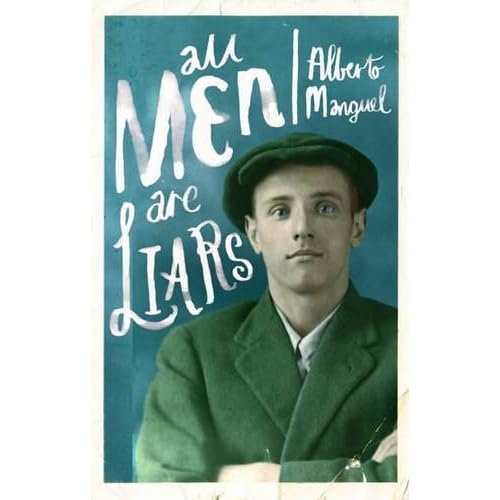
All men are liars, but you can't take that statement as the absolute truth. As Alberto Manguel says, inside the cover of the book, you can read the whole phrase from Psalms: 'I say in haste, all men are liars...'
It is not in haste, however, that I say I had a thoroughly enjoyable evening listening to Alberto speak with Maya. I felt so alive leaving the event, mainly because I love metafictional discussions, and though Alberto never used that word, he is all about metafiction. After all, he is the disciple of Borges ... but I'm sure Manguel was tired of discussing his relationship with Borges, so likewise, I'll talk about him last.
W
here to start, really? I first learned about Manguel when my father brought home a copy of this; he extolled about how trail-blazing Manguel was in being one of the first academics to write about the history of the act of reading. Nobody really paid serious attention to the phenomenon of reading as a cultural act until Manguel stepped into the scene. Well anyway, like the good daughter that I was, I didn't touch the book until it was assigned in an undergraduate course on Readers and Readership. It is an amazing book, very well-researched, and it makes you navel-gaze and examine yourself as a reader.
Anyway, the interviewer Maya Jaggi introduced him with a quote: 'Alberto Manguel is to reading what Casanova is to sex'. Ha. But I can confirm, he can make you get literally excited over books! He read aloud his latest novel, All Men Are Liars, and the novel sounded very intriguing indeed. He wrote it in Spanish even though he originally wanted to write it in English (he is Argentinian-Canadian, but his first language is English). He said that earlier on, he wanted to set the story in Canada, but found that Canadians are too nice (ha!) and had to move the story to Spain.
The metafictional bit is that in the story, he includes himself as a character, but he is the first to admit that Alberto Manguel the character 'is an asshole'. An audience member asked why he wanted to write himself into the book if he doesn't identify with the character much. His response reminded me of his earlier book ... in that he explained the act of telling a story is age old, harking back to cavemen sitting around campfires. People would enter into an unspoken agreement that whatever you say happened to you is to be taken as the truth, and that the listener will strive to believe you in the duration of your oral narrative. More than that, he says he believes that fiction/literature is the way to the truth. Though it hovers between lies and truths, 'literature has the last word ... I always trust in literature', but it takes time for books to be written. It takes time for events to settle down, for a writer to capture the sign of the times, time to train the readers to accept the stories and enjoy them and think about them. As he said, Joyce wasn't an instant bestseller. It took a lot of years to 'educate' readers to appreciate, say, Ulysses. (He then goes on to criticise the Anglo-publishing industry's obsession with churning out bestsellers instead of well-written novels...)
All Men Are Liars is a genre book of sorts, in the style of detective novels, as it presents different versions of the same character or event. Manguel points out that actually this style is not new. It is very old: you can also find it in the Gospels. How true! I never thought of it that way, that reading the Gospels is kinda like reading a detective novel where you try to piece the 'truth' of an event together (in the case of the Gospels, it is to piece together what really happened to Jesus, figuring out how reliable the different accounts are, etc).
Alberto goes on to talk about spies and informers ... how he is obsessed with how one can access the 'truth' about someone, or something ... when everyone can have different interpretations to the same person/event. He explained that this is because he was brought up in a good school in Buenos Aires, and he had an amazing teacher who opened up his mind to reading, and taught him that books can do wonders to your way of thinking ... but after he escaped from the years of the Dirty Wars (and lived in 'exile' ...) he found out that this very same teacher turned into an informer during the dictatorship period. He would report on his students' behaviours and was complicit in torture. How does one reconcile the two faces of the same man? Manguel says that he can do so through literature.
... and this leads naturally to his comment on Borges. Maya asked Alberto if he cares to speak about his relationship with Borges, the father of all modern literature. Manguel seemed slightly weary of the topic, but he was a good sport and gave what the audience wanted. After all, he met Borges as a teenager, and read aloud to him (Borges was near-blind). It was amazing hearing from someone who had first degree contact with Borges. Anyway, Manguel explained that whatever you want to write, Borges would have already written it.
Borges pointed out things that no one else had verbalised before until he did: that, for example, context matters a lot. That writing Don Quixote word for word now would create a totally different text to the Don Quixote written in Cervantes' time (as seen in 'Pierre Menard'). I know it's obvious now that context can be a very important thing to the interpretation and reception of a text, but actually it is quite a new phenomenon in the history of cultural criticism. That is, until Borges came along.
And the most amazing of all ideas, the reason why I love Borges so much: it is the fact that in real life, things can be quite black and white, but in literature, liminality and paradoxes occur. Manguel says: 'dogma gives you answers, but literature gives you questions'. How can you reconcile different types of truths? How can you believe Betty's version of something over Don's, for example? Maybe they are both correct? Literature can make you want to question deeply about things that you accept as truths .. make you dream about an alternate reality where impossible things can become possible. It then can motivate you to want to turn these impossible things into real things in real life (in other words, literature can incite change, politically and psychologically). Anyway, Manguel's example of how Borges illustrated this concept is through his reading of Dante's Inferno. If you have studied the Inferno in class, you would know that every Dante scholar loves to argue about the grotesque episode of Ugolino: since Dante doesn't say explicitly, scholars would argue over whether Ugolino's presented as having eaten his children or not. Ugolino was a real person in history, and so, Borges pointed out: in real life, either Ugolino ate his children or he did not. But in literature, he ate his children and he did not.
You probably think I'm sounding like a literary lunatic, but really, the most beautiful ability in the world is to hold two disparate, opposite thoughts at once, and not find that problematic. If you agree with me, then you will enjoy reading 'The Garden of Forking Paths'. I challenge you to read it and not have your mind blown away by Borges' short story.
I just realised I digressed into Borges. Oops. Alberto Manguel is an amazing individual! It was a wonderful hour of discussion, which reminds me: I will read his new novel, once I finish the pile of unread books in my room ...
Location: Foyles, London
All men are liars, but you can't take that statement as the absolute truth. As Alberto Manguel says, inside the cover of the book, you can read the whole phrase from Psalms: 'I say in haste, all men are liars...'
It is not in haste, however, that I say I had a thoroughly enjoyable evening listening to Alberto speak with Maya. I felt so alive leaving the event, mainly because I love metafictional discussions, and though Alberto never used that word, he is all about metafiction. After all, he is the disciple of Borges ... but I'm sure Manguel was tired of discussing his relationship with Borges, so likewise, I'll talk about him last.
W
Anyway, the interviewer Maya Jaggi introduced him with a quote: 'Alberto Manguel is to reading what Casanova is to sex'. Ha. But I can confirm, he can make you get literally excited over books! He read aloud his latest novel, All Men Are Liars, and the novel sounded very intriguing indeed. He wrote it in Spanish even though he originally wanted to write it in English (he is Argentinian-Canadian, but his first language is English). He said that earlier on, he wanted to set the story in Canada, but found that Canadians are too nice (ha!) and had to move the story to Spain.
The metafictional bit is that in the story, he includes himself as a character, but he is the first to admit that Alberto Manguel the character 'is an asshole'. An audience member asked why he wanted to write himself into the book if he doesn't identify with the character much. His response reminded me of his earlier book ... in that he explained the act of telling a story is age old, harking back to cavemen sitting around campfires. People would enter into an unspoken agreement that whatever you say happened to you is to be taken as the truth, and that the listener will strive to believe you in the duration of your oral narrative. More than that, he says he believes that fiction/literature is the way to the truth. Though it hovers between lies and truths, 'literature has the last word ... I always trust in literature', but it takes time for books to be written. It takes time for events to settle down, for a writer to capture the sign of the times, time to train the readers to accept the stories and enjoy them and think about them. As he said, Joyce wasn't an instant bestseller. It took a lot of years to 'educate' readers to appreciate, say, Ulysses. (He then goes on to criticise the Anglo-publishing industry's obsession with churning out bestsellers instead of well-written novels...)
Alberto goes on to talk about spies and informers ... how he is obsessed with how one can access the 'truth' about someone, or something ... when everyone can have different interpretations to the same person/event. He explained that this is because he was brought up in a good school in Buenos Aires, and he had an amazing teacher who opened up his mind to reading, and taught him that books can do wonders to your way of thinking ... but after he escaped from the years of the Dirty Wars (and lived in 'exile' ...) he found out that this very same teacher turned into an informer during the dictatorship period. He would report on his students' behaviours and was complicit in torture. How does one reconcile the two faces of the same man? Manguel says that he can do so through literature.
... and this leads naturally to his comment on Borges. Maya asked Alberto if he cares to speak about his relationship with Borges, the father of all modern literature. Manguel seemed slightly weary of the topic, but he was a good sport and gave what the audience wanted. After all, he met Borges as a teenager, and read aloud to him (Borges was near-blind). It was amazing hearing from someone who had first degree contact with Borges. Anyway, Manguel explained that whatever you want to write, Borges would have already written it.
Borges pointed out things that no one else had verbalised before until he did: that, for example, context matters a lot. That writing Don Quixote word for word now would create a totally different text to the Don Quixote written in Cervantes' time (as seen in 'Pierre Menard'). I know it's obvious now that context can be a very important thing to the interpretation and reception of a text, but actually it is quite a new phenomenon in the history of cultural criticism. That is, until Borges came along.
And the most amazing of all ideas, the reason why I love Borges so much: it is the fact that in real life, things can be quite black and white, but in literature, liminality and paradoxes occur. Manguel says: 'dogma gives you answers, but literature gives you questions'. How can you reconcile different types of truths? How can you believe Betty's version of something over Don's, for example? Maybe they are both correct? Literature can make you want to question deeply about things that you accept as truths .. make you dream about an alternate reality where impossible things can become possible. It then can motivate you to want to turn these impossible things into real things in real life (in other words, literature can incite change, politically and psychologically). Anyway, Manguel's example of how Borges illustrated this concept is through his reading of Dante's Inferno. If you have studied the Inferno in class, you would know that every Dante scholar loves to argue about the grotesque episode of Ugolino: since Dante doesn't say explicitly, scholars would argue over whether Ugolino's presented as having eaten his children or not. Ugolino was a real person in history, and so, Borges pointed out: in real life, either Ugolino ate his children or he did not. But in literature, he ate his children and he did not.
You probably think I'm sounding like a literary lunatic, but really, the most beautiful ability in the world is to hold two disparate, opposite thoughts at once, and not find that problematic. If you agree with me, then you will enjoy reading 'The Garden of Forking Paths'. I challenge you to read it and not have your mind blown away by Borges' short story.
I just realised I digressed into Borges. Oops. Alberto Manguel is an amazing individual! It was a wonderful hour of discussion, which reminds me: I will read his new novel, once I finish the pile of unread books in my room ...
Wednesday, 3 November 2010
Architecture: A Very Short Introduction
Title: Architecture: A Very Short Introduction
Author: Andrew Ballantyne (OUP)
This short little book has an idiosyncratic way of presenting architecture. Throughout the text, Ballantyne tries to explain that he's writing a very euro-centric view of architecture, but why is this not stated right at the start? The title or the blurb could give a better indication of this.
The IFC (inside front cover) text begins with:
Another reason why this book is eccentric is that the writer doesn't cover the history of architecture in a chronological way, and not even really by theme, but by whatever he wants to go on about, like how we can find continuity in 'modern' and antiquated buildings by looking at interesting buildings like the Chiswick House.
Chiswick House?! Rather random. Granted, it is in the Palladian style, but if you're going to pick 20 buildings to talk about in your grand narrative, you really wouldn't pick Chiswick House! What a myopic take.
Ballantyne purports that 'canonic buildings' shouldn't be seen as having timeless value, that buildings are not intrinsically good or bad but that culture instills meaning into the buildings. So the Parthenon is not amazing in itself, but that throughout history, each generation prescribes meaning to the Parthenon so that we will find something in it as being 'amazing'. All of this sounds wonderfully post-structuralist (if post-structuralism is defined as the necessity to study both the object itself as well as the systems of knowledge that produced that object), but 90% of the buildings he mentions in this book are classically canonic - the Egyptian pyramids, Roman temples, Parthenon, Frank Lloyd Wright, etc.
So at rare times, he digresses onto random structures like Chiswick House, but generally, though he tries to explain why, for example, the pyramids are so highly regarded then as well as now, he writes mainly from the basis that if you don't agree that the pyramids are one of the wonders of the world, then you are an uneducated lunatic.
Not to give you the wrong impression, I did enjoy reading this book. It was a quick read, and I learned something new: the Seagram Building in New York is the first 'modern commercial building' ever. It looks very unimpressive nowadays and no tourist would visit it because of the very fact that every commercial building now imitates it. So that's kinda cool. (Note: I was told that I'm an idiot for not knowing the significance of the Seagram Building before ... oops).
Also, another interesting point Ballantyne discusses is how people are still motivated to travel around the world to see architecture, when armchair travelling is so readily available. What makes one want to go to Egypt to see the 'real' pyramids, if you've already been inundated with the images of the pyramids throughout your life? Or the Sydney Opera House, for that matter? Why visit Australia then? It is the sense of being familiar yet unfamiliar, real yet unreal. In terms of where this perspective sits, I guess it's a bit Derrida here and a bit Baudrillard there.
I'm currently re-reading Allen Ginsberg's Howl, but following that I'm hoping to get a copy of McEwan's Solar.
Author: Andrew Ballantyne (OUP)
The IFC (inside front cover) text begins with:
'The balance of posterity and practicality in architecture throughout history, and its cultural relevance ... are skillfully examined in this Very Short Introduction.'That's incorrect! Ballantyne does not cover architecture 'throughout history'; he only covers Western history, and not even that, just key sections of the history that he feels are important. He doesn't mention Renaissance buildings or Art Deco buildings, which was quite significant in 20th century architecture. But he does write a lot about the Art Nouveau style, which I think is less important in the history of Architecture. I make complaints about misleading book titles frequently ... but I really believe it's a legitimate complaint. It is very presumptuous and arrogant to claim to write the history of anything, and then not actually covering everything.
Another reason why this book is eccentric is that the writer doesn't cover the history of architecture in a chronological way, and not even really by theme, but by whatever he wants to go on about, like how we can find continuity in 'modern' and antiquated buildings by looking at interesting buildings like the Chiswick House.
Chiswick House?! Rather random. Granted, it is in the Palladian style, but if you're going to pick 20 buildings to talk about in your grand narrative, you really wouldn't pick Chiswick House! What a myopic take.
Ballantyne purports that 'canonic buildings' shouldn't be seen as having timeless value, that buildings are not intrinsically good or bad but that culture instills meaning into the buildings. So the Parthenon is not amazing in itself, but that throughout history, each generation prescribes meaning to the Parthenon so that we will find something in it as being 'amazing'. All of this sounds wonderfully post-structuralist (if post-structuralism is defined as the necessity to study both the object itself as well as the systems of knowledge that produced that object), but 90% of the buildings he mentions in this book are classically canonic - the Egyptian pyramids, Roman temples, Parthenon, Frank Lloyd Wright, etc.
So at rare times, he digresses onto random structures like Chiswick House, but generally, though he tries to explain why, for example, the pyramids are so highly regarded then as well as now, he writes mainly from the basis that if you don't agree that the pyramids are one of the wonders of the world, then you are an uneducated lunatic.
Not to give you the wrong impression, I did enjoy reading this book. It was a quick read, and I learned something new: the Seagram Building in New York is the first 'modern commercial building' ever. It looks very unimpressive nowadays and no tourist would visit it because of the very fact that every commercial building now imitates it. So that's kinda cool. (Note: I was told that I'm an idiot for not knowing the significance of the Seagram Building before ... oops).
Also, another interesting point Ballantyne discusses is how people are still motivated to travel around the world to see architecture, when armchair travelling is so readily available. What makes one want to go to Egypt to see the 'real' pyramids, if you've already been inundated with the images of the pyramids throughout your life? Or the Sydney Opera House, for that matter? Why visit Australia then? It is the sense of being familiar yet unfamiliar, real yet unreal. In terms of where this perspective sits, I guess it's a bit Derrida here and a bit Baudrillard there.
I'm currently re-reading Allen Ginsberg's Howl, but following that I'm hoping to get a copy of McEwan's Solar.
Subscribe to:
Posts (Atom)